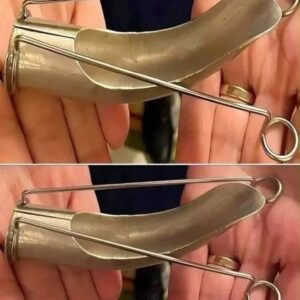
The moment felt heavier than it should have.
I still remember the weight of it in my hand, cold and unfamiliar, as if I’d just picked up proof that my life wasn’t what I thought. The closet was silent, but my thoughts were loud: betrayal, secrets, stories I never wanted to imagine. Every odd look, every late message, every unexplained moment suddenly replayed in my head, stitched together by fear.
Yet curiosity pushed harder than panic. I sat down, opened my phone, and searched. The result appeared within seconds, almost mocking in its simplicity: an applicator nozzle for silicone sealant. A tool. Nothing more. I laughed, but it came out shaky, half-relief, half-shame. In that tiny, ridiculous moment, I realized how fragile trust can feel—and how easily our own fears can turn an ordinary object into a weapon against the people we love.
For several minutes after that, I just sat there on the edge of the bed, staring at the little plastic piece resting in my palm. It looked so harmless now. Almost stupidly ordinary. The kind of thing you would walk past in a hardware store without noticing. Yet moments earlier, it had felt dangerous. My mind had transformed it into evidence before I even understood what it was.
That realization unsettled me more than the object itself.
Fear is strange like that. It doesn’t ask for proof. It builds stories first and searches for confirmation later. In those brief moments before I looked it up online, I had already created entire scenes in my head. I imagined lies hidden behind casual conversations. I imagined secret lives existing quietly beside our everyday routines. I imagined betrayal sitting comfortably inside our home while I remained blind to it.
And all of it came from a tiny plastic nozzle.
I leaned back and closed my eyes, embarrassed by how quickly my thoughts had spiraled. But if I’m honest, the object alone wasn’t the real reason I panicked. It was what had already been living quietly inside me long before I opened that wardrobe.
Stress. Distance. Silence.
The past few months had been difficult in ways that never make dramatic headlines. Nothing explosive had happened between us. No screaming arguments. No broken plates. No shocking confessions. Just the slow exhaustion that adulthood sometimes places on two people trying to survive life together.
We had both become busy. Too busy.
Conversations had turned practical instead of personal. We talked about bills, groceries, appointments, repairs around the house. We discussed schedules more than feelings. Some nights we sat in the same room scrolling through separate screens, physically close but mentally miles apart. It didn’t happen all at once. That’s the dangerous thing about emotional distance—it arrives quietly.
You don’t notice the change immediately.
You only notice it when something small suddenly feels suspicious.
Looking back, I realized my fear didn’t begin in that wardrobe. It began weeks earlier, maybe months earlier, in all the tiny insecurities I ignored instead of confronting. Every unanswered text that took too long. Every tired expression I misread. Every moment where affection felt rushed because life itself was rushed.
The human mind hates uncertainty. When connection weakens, imagination fills the empty space.
I remembered a conversation we’d had not long ago. She had come home late from work, exhausted, barely speaking before taking a shower and falling asleep. I had asked if everything was okay, and she simply said, “I’m tired.” At the time, I accepted the answer. But later, alone with my thoughts, I started wondering if “tired” meant something else.
That’s how suspicion grows—not from evidence, but from silence mixed with insecurity.
The worst part is how convincing those fears become once they start collecting memories. Suddenly your brain behaves like an investigator. It digs through ordinary moments searching for patterns that may not even exist. A missed call becomes suspicious. A distracted mood becomes meaningful. A random object inside a wardrobe becomes “proof.”
Sitting there that evening, I realized how dangerously easy it is to rewrite your entire relationship through the lens of fear.
I thought about how many people probably destroy trust this way. Not through actual betrayal, but through assumptions. Through stories invented in private moments of anxiety. Through conclusions reached before conversations ever happen.
And honestly, part of me understood why.
Love makes people vulnerable. The deeper you care about someone, the more terrifying it becomes to imagine losing them. Sometimes the fear of betrayal becomes so powerful that the mind starts preparing for heartbreak before heartbreak even exists. It feels safer to suspect than to trust completely.
But there’s a cost to living that way.
As I sat there holding that ridiculous silicone nozzle, I realized I had allowed fear to temporarily replace reason. Worse, I had allowed it to distort the image of someone I loved.
My wife had done nothing wrong.
She wasn’t hiding secrets. She wasn’t betraying me. Most likely, she had simply kept the nozzle after helping with some repair project months ago. Something ordinary. Something forgettable.
Meanwhile, I had mentally built an entire courtroom around it.
The shame of that hit me slowly.
Not because suspicion itself is evil—everyone feels insecure sometimes—but because I understood how unfair silent accusations can become. Relationships cannot survive if every unexplained detail automatically becomes evidence of betrayal.
Trust is more fragile than people admit.
It doesn’t usually collapse in one dramatic moment. More often, it erodes through repeated doubt, through private assumptions, through fear left unspoken until it quietly poisons the way we see each other.
I walked into the kitchen afterward and poured myself a glass of water, still laughing awkwardly at my own panic. The laughter helped, but it also exposed something uncomfortable: I wasn’t really laughing at the object. I was laughing at how human I had just been.
How quickly certainty disappeared.
How quickly fear took control.
How quickly imagination outran reality.
When my wife came home later that evening, she immediately noticed something strange in my expression. She asked if I was okay, and for a second I considered pretending everything was normal. But instead, I told her the truth.
Not every detail.
I didn’t dramatically confess the absurd theories I’d invented in my head. But I told her I found the object, didn’t recognize it, panicked for a moment, then realized it was harmless.
To my surprise, she burst out laughing.
Not cruel laughter. Genuine, uncontrollable laughter. The kind that bends your shoulders forward and forces tears into your eyes. After catching her breath, she explained exactly where it came from: months earlier, she had used it while helping her brother seal part of a bathroom sink installation. She had tossed it into the wardrobe afterward and forgotten about it entirely.
The simplicity of the explanation made the entire situation even more ridiculous.
Eventually I started laughing too.
But underneath the humor was an important realization neither of us ignored.
That tiny misunderstanding revealed something real about us.
Not betrayal. Not dishonesty. Something quieter.
Fatigue.
Distance.
The emotional static that accumulates when two people become overwhelmed by life and stop truly checking in with each other. The object itself meant nothing, but my reaction to it meant something. It exposed anxieties I hadn’t acknowledged out loud.
That night we talked longer than we had in weeks.
Not because of the nozzle itself, but because it accidentally forced honesty into the room. We talked about stress. About exhaustion. About how easy it is to feel disconnected without meaning to. We admitted that routine had slowly replaced presence.
Marriage is strange that way. People think relationships are tested only by major tragedies or dramatic betrayals. But sometimes the real test is whether two people notice the quiet drift before it becomes permanent.
Sometimes danger doesn’t arrive as chaos.
Sometimes it arrives as emotional distance disguised as normal life.
The older I get, the more I realize how vulnerable the human mind becomes when left alone with uncertainty. Silence is powerful. When people stop communicating openly, imagination steps in to complete the missing sentences.
And imagination rarely chooses the most peaceful explanation.
It chooses the one charged with fear.
That experience stayed with me long after the embarrassment faded. Not because the situation itself mattered, but because it reminded me how perception works. We don’t see reality exactly as it is—we see reality filtered through our emotional state.
A secure mind sees an object and asks questions.
An anxious mind sees an object and creates accusations.
The difference matters.
I also realized how many unnecessary conflicts probably begin this exact way. Someone notices something small. Instead of communicating, they investigate privately. Fear grows in isolation. Assumptions harden into beliefs. By the time a conversation finally happens, resentment has already formed around a misunderstanding.
All because imagination moved faster than truth.
There’s another uncomfortable truth too: modern life constantly feeds suspicion. Movies, social media, online stories—they train people to expect hidden meanings everywhere. Every unusual detail feels like a clue. Every behavioral change feels suspicious. We consume endless narratives about betrayal until trust itself starts feeling naive.
That mindset can quietly damage real relationships.
Not because caution is wrong, but because hypervigilance changes the way people interpret ordinary life. Once suspicion becomes a habit, even harmless moments start carrying emotional weight they were never meant to hold.
I think that’s why the experience shook me more than I expected. It forced me to confront how easily fear can manipulate perception. For a few moments, I genuinely believed I had discovered something devastating. My emotions reacted as if betrayal were already real.
My heart raced.
My stomach tightened.
My thoughts spiraled.
Yet reality remained completely ordinary the entire time.
That disconnect fascinated me afterward. The body responds to imagined threats almost as intensely as real ones. The mind can create suffering from uncertainty alone.
And perhaps that’s one of the hardest parts of loving someone deeply: accepting uncertainty without allowing it to consume you.
Because trust is never absolute certainty. It’s a choice made despite uncertainty.
That doesn’t mean ignoring obvious problems or pretending betrayal never happens. It means resisting the urge to build conclusions from fragments. It means giving communication a chance before fear takes over.
Looking back now, the whole situation feels almost funny. A silicone sealant nozzle became the center of an emotional crisis that existed entirely inside my own head. But beneath the humor was a lesson I genuinely needed.
Fear distorts.
Silence amplifies.
Assumptions multiply.
And trust, once shaken by imagination, requires honesty to steady itself again.
Sometimes people think strong relationships are built through grand romantic gestures. Expensive trips. Dramatic declarations. Perfect moments. But I think real strength often appears in smaller, less glamorous ways.
In difficult conversations.
In vulnerable honesty.
In admitting insecurity instead of hiding it behind anger.
In choosing clarification over accusation.
That evening could have gone differently. I could have stayed silent and allowed suspicion to linger privately. I could have started interpreting future events through that same fearful lens. I could have let embarrassment prevent communication.
Instead, something simple happened: we talked.
And somehow, that mattered more than the object itself ever did.
Now, whenever I think back to that moment, I don’t really remember the fear first. I remember sitting together afterward, laughing at how absurd the misunderstanding became. I remember the relief of realizing nothing terrible had happened. And I remember understanding, maybe more clearly than before, that trust is not maintained automatically.
It requires attention.
It requires communication.
And sometimes it requires recognizing when your own fears are telling stories reality never actually wrote.
That tiny plastic nozzle eventually ended up where it belonged—in a drawer filled with random household tools and forgotten repair supplies. Just another ordinary object among many others.
But the lesson it left behind stayed with me much longer.
Not every mystery hides betrayal.
Not every silence contains secrets.
And sometimes the scariest stories are the ones we quietly create ourselves.