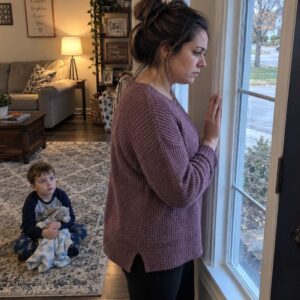
Neighbors remember the chaos with a clarity that feels almost unnatural, as though the moment carved itself permanently into their minds. It began with a sound that did not belong to the calm rhythm of their street—sirens, sharp and relentless, cutting through the stillness of the morning. At first, many assumed it was a passing emergency, something distant and unrelated. But the sirens did not fade. They grew louder, closer, multiplying until the quiet neighborhood was overtaken by a storm of flashing lights and urgent movement.
Blue and red reflections danced across windows and walls, staining the familiar surroundings with an unfamiliar tension. Doors opened cautiously. Curtains shifted. People stepped outside, drawn by a mixture of concern and curiosity. What they saw unsettled them immediately—police vehicles lining the street, officers moving with purpose, voices low but urgent. Something was very wrong.
What had once been just another home—one among many—had suddenly become the center of something dark and incomprehensible.
Inside, investigators were met with a scene that would stay with them long after they left. It was not just the physical evidence that disturbed them, but the atmosphere itself. The house carried a silence that felt heavy, almost deliberate, as though it was holding onto secrets it refused to release. Rooms that once echoed with laughter and routine now stood frozen in time, disrupted in ways that raised more questions than answers.
There were signs of a struggle, but nothing immediately explained what had happened or why. No clear motive, no obvious suspect, no immediate story that could tie everything together. It was, as one officer later described, “a home turned into a crime scene with no clear answer why.”
For the father, the tragedy unfolded in a way that felt almost unreal. His day had begun like any other—ordinary, predictable, safe. There were no warnings, no signs that anything was about to change. He left home with the quiet confidence that comes from routine, expecting to return to the life he knew.
But when he came back, that life was gone.
The moment he saw the police presence, something inside him shifted. Confusion gave way to dread, and dread quickly became something far worse. Time seemed to slow, each second stretching into something unbearable as he tried to understand what he was seeing, what it meant, what had happened in the place he called home.
The truth, when it reached him, did not arrive all at once. It came in fragments—carefully delivered, incomplete, difficult to process. Words that should never have to be spoken were spoken. Questions that had no answers began to form.
And just like that, everything changed.
In the days that followed, the neighborhood transformed. The familiar routines of daily life were replaced by a quiet, collective grief. People spoke in hushed tones, as though raising their voices might disturb something fragile and unresolved. Conversations revolved around the same questions, repeated over and over without resolution.
How could this happen here?
Who would do something like this?
Why?
There were no answers—only speculation, fear, and a growing sense that something deeply unsettling had occurred without explanation.
Funerals replaced family dinners. The simple rituals that once defined normal life were overshadowed by mourning and disbelief. For those who knew the family, the loss felt personal. For those who did not, it still felt close enough to disturb their sense of safety.
For the father, grief did not arrive in a single, overwhelming wave. It came in layers, each one revealing a new depth of pain. At times, it was sharp and immediate—a sudden realization, a memory that refused to stay in the past. At other times, it was quieter but no less powerful, settling into the spaces where routine once lived.
His days became a cycle of questions and reflections. He found himself replaying moments, searching for something—anything—that might explain what had happened. Every conversation, every argument, every silence took on new significance. Things that once seemed small now felt important, as though they might hold a clue he had missed.
Was there a warning?
A sign?
Something he should have seen?
These questions did not bring comfort. They only deepened the sense of uncertainty, reinforcing the painful reality that some things cannot be understood, no matter how closely they are examined.
Authorities continued their work, moving methodically through the details of the case. They followed leads, interviewed neighbors, examined relationships, and tried to reconstruct a timeline that made sense of the chaos. Every piece of evidence was analyzed, every possibility considered.
But progress was slow.
Each new development seemed to raise as many questions as it answered. Leads that initially appeared promising faded under closer scrutiny. Motives remained unclear. The absence of a clear explanation became one of the most troubling aspects of the case.
It was not just a tragedy—it was a mystery.
For the community, this uncertainty created a lingering unease. Without answers, there was no closure. Without closure, there was no way to fully move forward. The event remained present, not just as a memory but as an unresolved reality.
People began to look at their surroundings differently. The sense of safety that once defined the neighborhood had been disrupted. Ordinary sounds took on new meanings. Unfamiliar faces were noticed more quickly. Trust, once given freely, became more cautious.
The house itself stood as a reminder—a physical representation of something that had changed the community forever. Even as time passed, it remained difficult to see it as just another home. It carried a weight that could not easily be ignored.
For the father, the passage of time did not bring the relief that many expect. If anything, it made the absence more pronounced. The initial shock faded, but in its place came a deeper, more persistent awareness of what had been lost.
There were moments when the reality of it all felt distant, almost unreal. And then, without warning, it would return with full force—a memory, a familiar place, a simple routine that no longer existed.
Grief is often described as something that lessens over time, but for him, it did not feel that way. It changed, it evolved, but it did not disappear. It became something he carried with him, shaping his days in ways both visible and unseen.
Even as authorities continued their investigation, the question of justice remained uncertain. Would there be answers? Would those responsible be found? Would there ever be a moment when the story made sense?
These questions lingered, unanswered.
For some, justice represents closure—a way to make sense of the senseless. For others, it is simply a necessary step, a way to ensure that what happened is acknowledged and addressed. But for the father, even the possibility of justice felt complicated.
Because no outcome, no explanation, no resolution could undo what had been done.
The life he had known was gone, replaced by something he never could have imagined. The future he once envisioned no longer existed. In its place was a reality defined by absence, by questions, by a search for meaning in something that may never fully make sense.
And yet, life continued.
Days passed. Routines slowly reformed. The world, indifferent to individual tragedy, moved forward. But for those directly affected, time did not erase what had happened. It only created distance, a space in which memory and reality coexisted in a way that was both painful and necessary.
The neighborhood, too, began to adjust. The initial intensity of the event softened, but it was never forgotten. It became part of the community’s history, a moment that would always be remembered as the day everything changed.
People still spoke about it, though less frequently. The conversations became quieter, more reflective. The urgency faded, replaced by a lingering awareness that some questions remain unanswered.
And perhaps always will.
For the father, the journey forward is not about forgetting or even fully understanding. It is about learning how to exist within a reality that has been permanently altered. It is about carrying the weight of what was lost while continuing to move through the world.
He now lives each day with a kind of awareness that few can truly understand—the awareness of how quickly everything can change, how fragile even the most stable life can be.
The absence is constant.
The questions remain.
And the search for meaning continues, not because it will necessarily bring answers, but because it is the only way forward in a world that no longer feels the same.
In the end, this tragedy is not defined solely by what happened, but by what remains—the memories, the unanswered questions, and the quiet, enduring impact on those who are left behind.